


Borrowing money is something many people do at different points in life.
Whether it is covering an unexpected cost, spreading out a larger purchase, or managing cash flow, both personal loans and credit cards are common options.
But if you are weighing up your options, the answer is not always obvious.
Both can work well in the right situation.
The difference often comes down to:
• how you repay what's borrowed
• how easy they are to manage
• whether they could lead to more debt
This guide explains the difference in simple terms, so you can understand what may suit your needs and budget.
Personal loans and credit cards explained simply
Before comparing anything, it helps to understand how each option works in practice.
Personal loans
A personal loan gives you a fixed amount of money upfront. You repay it in set monthly instalments over an agreed period.
• you know how much you are borrowing
• you know how long you will repay it for
• your monthly repayments stay the same
In most cases, the structure is designed so the debt is fully cleared by the end of the term.
Credit cards
A credit card gives you access to a credit limit that you can use when needed.
• you can borrow, repay and borrow again
• you choose how much to repay each month, as long as you meet the minimum
• there is no fixed end date
If you do not repay the full balance, interest is usually charged on what remains.
What does responsible borrowing mean?
When people talk about responsible borrowing, they are usually talking about control, affordability and predictability.
Responsible borrowing tends to mean:
• you know exactly what you owe and when it will be repaid
• your repayments are manageable and consistent
• there is a clear end point
• the risk of the balance growing over time is limited
Why personal loans can offer more structure
1. You know exactly what you will pay
With a personal loan, everything is outlined from the beginning.
You can see:
• your monthly repayment
• the length of the agreement
• the total amount you will repay
That clarity can make it easier to plan your finances and understand what you are committing to from the start.
2. They can reduce the risk of long-term debt
One of the biggest differences between loans and credit cards is how the debt could grow.
A personal loan has a defined end point. Once you have made all your repayments, the balance is cleared.
A credit card, on the other hand, is open-ended. If you only repay minimum payments, the debt can last much longer than expected.
Research shows millions of credit card accounts in the UK remain in persistent debt, where balances are carried for extended periods with little reduction.
That open-ended structure is what can make credit cards feel less predictable over time.
3. Lower typical interest for larger borrowing
For larger amounts, personal loans often come with lower typical interest rates than credit cards.
Credit cards can carry higher APRs, especially once any introductory offer ends, so it is important to look carefully at the rate, term and total amount repayable before choosing how to borrow.
This means a loan may feel more predictable for planned borrowing over a longer period, because repayments are set out upfront.
4. Built around structured affordability
Personal loans are usually designed with affordability in mind from the outset.
Repayments are calculated to be spread over time in a manageable way, based on your financial situation. That structure can help reduce uncertainty and make borrowing feel more aligned with your monthly budget.
Where credit cards can need more careful management
Credit cards can be useful, but their flexibility means they often need more active management.
Some of the common challenges include:
• Minimum payments can slow progress: paying only the minimum can keep the balance going for much longer than expected
• Interest can increase quickly: especially after introductory offers, rates can rise to much higher levels.
• Easy to keep borrowing: because the credit is reusable, it can be harder to fully clear the balance
• Less certainty month to month: payments can change depending on choices and remaining balance
None of this means a credit card is the wrong choice. It simply means it is important to have a clear repayment plan, especially if you are not clearing the balance in full each month.
When a credit card might still make sense
There are still situations where a credit card can be a practical option.
For example:
• smaller, everyday purchases
• short-term borrowing
• when you are confident you can repay the balance in full
• when you want the added purchase protection that can come with using a credit card
In these cases, flexibility can be useful. The key is being clear on how and when the balance will be repaid.
A simple way to decide what suits you
If you are weighing up both options, it can help to think in simple terms.
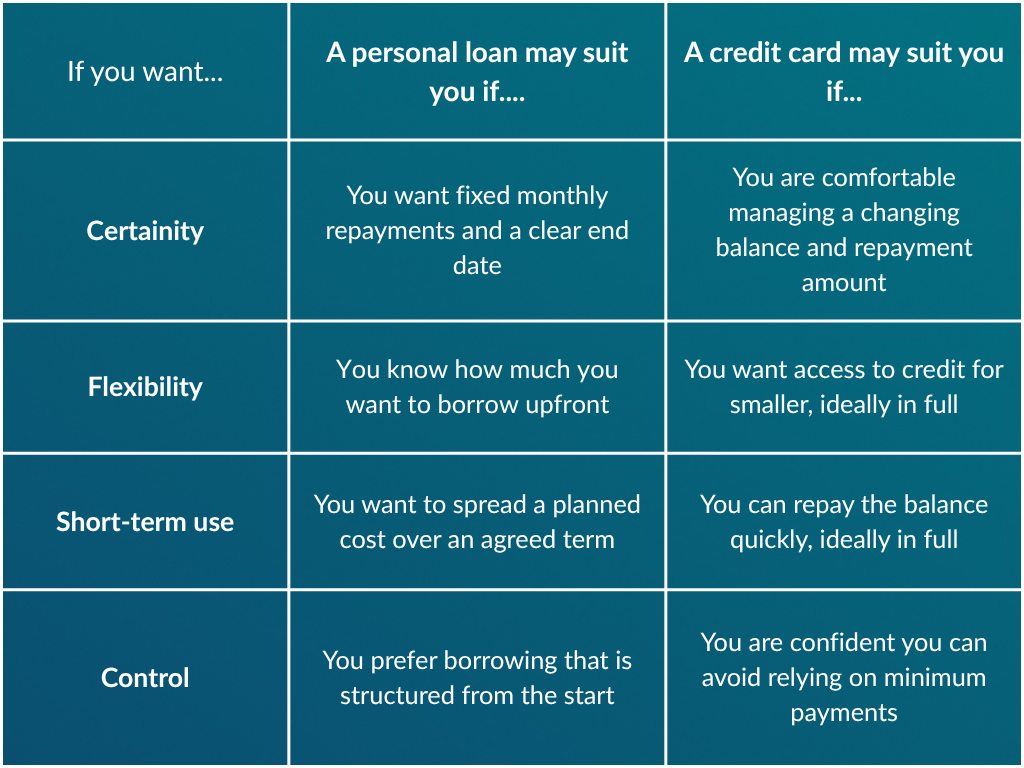
There is no one-size-fits-all answer. The right choice depends on what you need the money for, how quickly you can repay it, and what feels manageable within your monthly budget.
Know the risks
Taking out a loan means committing to regular repayments over a set period and missing those payments can negatively impact your credit score, result in additional fees, and make future borrowing more difficult.
It's important to remember that borrowing more than you can comfortably afford may cause financial strain.
Take time to carefully consider the type of loan that best suits your needs, as well as the term and amount that are suitable and affordable to you. If you are a homeowner, you can apply for a secured loan and might be asked to put your home up as collateral against the loan.
YOUR HOME IS AT RISK. THINK CAREFULLY BEFORE SECURING OTHER DEBTS AGAINST YOUR HOME. YOUR HOME MAY BE REPOSSESSED IF YOU DO NOT KEEP UP REPAYMENTS ON A MORTGAGE OR ANY OTHER DEBT SECURED ON IT.
At V12 Personal Finance, we encourage responsible borrowing. Our personal loan eligibility checker and personal loan calculator can help you explore your options, understand what may be available, and check eligibility with no impact on your credit rating at the eligibility check stage.
It's important to remember that a full credit search will be carried out once you've chosen to apply for a loan with your chosen lender, and Credit
Reference Agencies may keep a record of that search.
Borrowing that works around your life
When borrowing works well, it tends to sit quietly in the background. You understand it, you expect it, and it fits comfortably into your monthly routine.
When it feels uncertain or difficult to track, it can quickly become a source of stress.
That is why structure, clarity and time to think things through are so important.
Check your personal loan eligibility
If you are still deciding, exploring your options can be a helpful first step.
Checking your eligibility, without any impact on your credit score, can give you a clearer picture of what might be available, without any obligation to take things further.
It is simply a way to understand your choices, so you can decide what feels right for you.
Take the first step and check your eligibility
CHECK ELIGIBILITY BUTTON